Top 5 Most Failed Trick Questions
on the Japanese Written Driving Test
"I've studied hard using the app, so I won't fall for trick questions!" ...Are you sure about that?
Actually, the more diligently you study the textbook, the easier it is to fall into the traps of linguistic nuances and subtle legal details on the Japanese written driving test.
By analyzing our database of over 210,000 practice test answers on Menkyo Tottaru Academy, we've identified the "Top 5 Demon Questions" that consistently trip up foreign learners, with an astonishingly low accuracy rate in the 10-20% range!
In this article, a veteran driving instructor with 25 years of experience reveals the psychology behind why so many learners get these wrong, particularly focusing on differences from traffic laws in other countries and the nuances of English translations. Check this ultimate guide before your final exam!
Rank 5: Protecting Vulnerable Pedestrians (Accuracy: 21.7%)
If a person with a white or yellow cane, or an elderly person with difficulty walking, is on the road, you must slow down and pass with a safe distance.
In Japanese traffic law, individuals carrying a white or yellow cane, people using wheelchairs, and elderly individuals with mobility issues are classified as highly vulnerable pedestrians who require absolute protection.
Therefore, simply reducing your speed ("slowing down") or keeping a gap is legally insufficient. To protect them properly, you must either "come to a complete stop" or "proceed at a crawl" (徐行 - jokou).
*Note: "Crawl" (徐行) specifically means driving at a speed from which you can stop immediately, typically under 10 km/h. "Slowing down" just means reducing your current speed, which might still be too fast.
In real-world driving, a pedestrian might stumble or unexpectedly change direction to avoid a puddle. If you are just "slowing down," you won't be able to prevent a collision. Whenever you see a question involving vulnerable pedestrians, remember: half-measures like "safe distance" or "slow down" are incorrect. Absolute protection means stopping or crawling!
Rank 4: Left Turns at Intersections (Accuracy: 20.0%)
When turning left at an intersection, a vehicle must move to the left edge in advance and turn promptly along the edge of the intersection.
It is absolutely true that you must move to the left edge of the road in advance before turning left. This is to block motorcycles or bicycles from sneaking up on your inside, preventing deadly left-hook accidents. However, the action of turning "promptly" or quickly is extremely dangerous.
At Japanese intersections, you must always turn "at a crawl" (徐行). Why? Because pedestrians or cyclists might be crossing the road you are turning into. If you turn promptly, you won't have enough time to react and hit the brakes if someone suddenly appears in the crosswalk.
In Japanese traffic law, safety always supersedes speed. Whenever an exam question suggests performing an intersection maneuver "promptly" or "quickly," it is almost guaranteed to be a trap. Slow and steady is the golden rule.
Rank 3: Misinterpreting Pedestrian Signs (Accuracy: 19.0%)
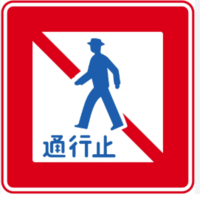
This sign indicates “No pedestrian crossing.”
"Pedestrians Prohibited" signs are typically found at the entrances of expressways, bypasses, or long tunnels where it is fatally dangerous for anyone to walk. "No Pedestrian Crossing," on the other hand, is usually placed in busy urban areas to stop people from jaywalking across wide, dangerous avenues.
Visualizing the English translation can be tricky, but here is a simple memory trick: If the sign just shows a person walking with a red slash or red border across it, it means "Don't walk here AT ALL." Misinterpreting these signs on the actual test is incredibly common, so make sure you review them carefully!
Rank 2: Approaching a Stopped School Bus (Accuracy: 18.8%)
When a school/kindergarten bus is stopped to let children on or off, you must come to a complete stop and check safety.
In many countries (like the United States), it is strictly required by law to come to a "complete stop" when a school bus is loading or unloading children, and passing a stopped school bus is a severe offense. Many foreign test-takers apply this logic to Japan and confidently answer "True."
However, Japan's traffic law dictates a different approach. When you encounter a stopped school bus or kindergarten bus, you are NOT legally required to come to a complete stop. Instead, you must "proceed at a crawl (徐行) and confirm safety" as you pass, to ensure no children suddenly run out from in front of or behind the bus.
While stopping entirely is certainly a safe driving practice, the exam strictly tests your knowledge of Japanese law. For the written test, memorize this formula: "Stopped School Bus = Crawl and check safety, NOT a complete stop." Don't let your home country's common sense trick you!
Rank 1: The "No Overtaking" Sign Trap (Accuracy: 17.6%)
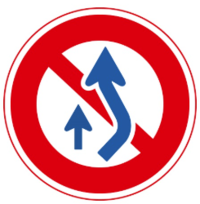
This sign is a regulatory sign meaning “No overtaking.”
In Japan, there is a round sign with a red border showing a red car passing a blue car. If you see just this sign by itself, it means "No crossing the center line to the right side for overtaking" (追い越しのための右側部分はみ出し通行禁止).
It does NOT mean "No Overtaking" entirely. You are still legally allowed to overtake a cyclist or a slow moped IF you can do so safely without your vehicle crossing over the center line.
So, what does an absolute "No Overtaking" (追い越し禁止) sign look like? It looks exactly the same, but it MUST be accompanied by a small rectangular supplementary plate (補助標識) underneath it that explicitly reads "追越禁止" (No Overtaking). If that plate is attached, you cannot overtake another vehicle even if you stay within your lane.
The Japanese testing authority loves to use this precise visual distinction to separate those who just skimmed the book from those who truly understand the rules. If there's no supplementary text plate, it only prohibits the *action of crossing the line* to pass. Memorize this visual difference, as it is a guaranteed point-saver on the real exam!
Hidden Dangers Behind Trick Questions
How did you do?
Trick questions on the Japanese driving test aren't just made to annoy you. They carry a strong message from the Public Safety Commission: "A slight misunderstanding of words or misinterpreting a sign can lead directly to a fatal accident in real-life driving."
When you are unsure during the actual exam, don't just try to recall the textbook. Instead, ask yourself: "Which action exposes pedestrians and other vehicles to the least amount of danger?" By thinking fundamentally about safety, the correct answer will often reveal itself. Solid knowledge is the strongest shield to protect yourself and your loved ones on the road.
About the Author

A professional with decades of hands-on experience at designated driving schools in Japan. A vehicle enthusiast who has conquered land and sea, guiding you straight to passing your exam! "Why did I get points deducted for that driving maneuver?"—He solves all your driving doubts.
Practice repeatedly with our app to pass your final exam on the first try!
Train to Pass!